
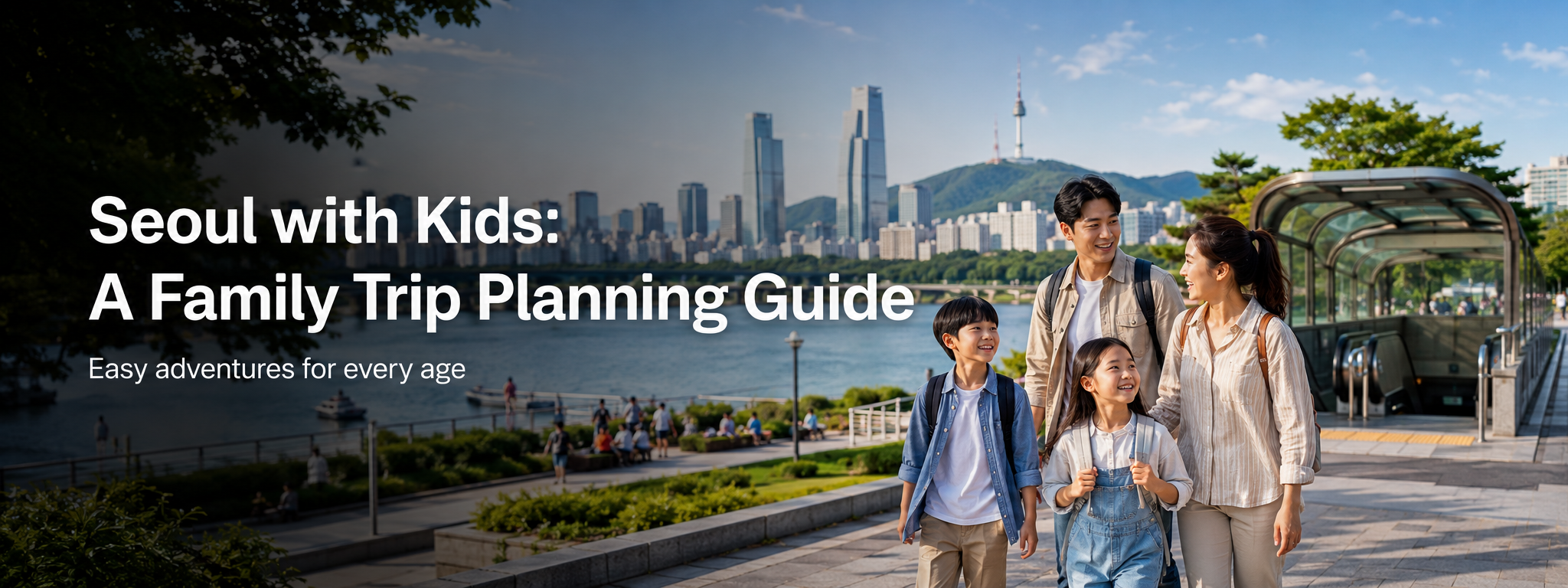

Is Seoul genuinely good for a family trip?
Yes — especially for families that like a mix of city life, food, museums, parks and big-ticket attractions. The subway network reaches almost everywhere a first-time visitor is likely to go, convenience stores make emergency snacks easy, and Seoul has enough indoor attractions to rescue a wet, humid or brutally cold day.
The catch is scale. Stations can involve long transfers, palace grounds are much bigger than they look on a map, and a “short” cross-city trip can consume the best part of an hour once you include walking. With children, I plan geographically rather than by ranking: one part of Seoul per half-day is usually the calmer choice.
Pick family anchors, then build around them
| Anchor | Why it works | Natural pairing |
|---|---|---|
| Seoul Children’s Grand Park | Large public park with zoo, playgrounds and family facilities | Seongsu or eastern Seoul |
| Seoul Children’s Museum | Hands-on indoor learning/play | Children’s Grand Park |
| Lotte World | Indoor + outdoor theme park; useful in poor weather | Jamsil / Seokchon Lake |
| National Museum of Korea | Large, weather-proof cultural anchor with family potential | Yongsan / Hangang |
| Han River parks | Space to run, picnic and reset after dense sightseeing | Choose the park nearest your day |
Seoul Children’s Grand Park is particularly useful because Seoul Metropolitan Government describes the park itself as free to enter, while some individual facilities are paid. Its mix of open space, zoo, botanical elements and play areas gives you room to change the plan without abandoning the whole day.
Lotte World is the obvious rainy-day big-ticket option
Lotte World in Jamsil combines a large indoor Adventure park with the outdoor Magic Island area. The indoor component is why it works so well in bad weather, although queues can still be substantial and outdoor rides may pause for weather or operational checks.
If theme parks are a major part of the trip, compare it with Everland in our Lotte World vs Everland guide. If they are not, there is no rule saying a family trip to Seoul must include either.
With younger kids, protect the middle of the day
Preschoolers usually cope better when the morning has one clear goal, lunch is not delayed until everyone is furious, and the afternoon has a flexible indoor or park option. I would rather leave a palace with everybody still cheerful than squeeze in one more gate because a checklist says it is “nearby”.
A hotel rest can be strategically valuable, especially in summer humidity or winter cold. That argues for staying somewhere with easy subway access rather than automatically chasing the cheapest room several transfers away.
Strollers and stations: Seoul is accessible, but not frictionless
Many subway stations have lifts, but the lift route can be much longer than the stairs/escalators and may emerge at a different street exit from the one you expected. Big interchanges can involve serious walking. If you are using a stroller, leave buffer time and use the accessible-exit information in your navigation app rather than assuming the closest numbered exit has a lift.
During rush hour, a bulky stroller on a packed train is stressful for everyone. Where possible, I avoid the commuter peaks and let the family day start half an hour later.
Food with children: keep one easy fallback
Korean food is not automatically difficult for children, but chilli, unfamiliar textures and shared-table ordering can create friction. Rice, grilled meat, gimbap, dumplings, noodles, soups and bakery/convenience-store food give you plenty of softer landings. For picky eaters, I keep one known fallback near the accommodation instead of turning every meal into a cultural test.
Allergy needs deserve more care because sauces, broths and shared preparation can hide ingredients. Our vegetarian/vegan guide has some useful communication context, but serious allergy travellers should carry a clearly translated allergy card.
Palaces, markets and neighbourhoods still work — just change the pace
Children do not need a separate parallel Seoul. Gyeongbokgung can work if you focus on visual scale and a few stories instead of demanding museum-level concentration. Markets can work if the goal is a snack crawl rather than “see every aisle”. Bukchon or Ikseon-dong can work if you accept that narrow lanes and crowds are not stroller heaven.
The family version of good planning is usually subtraction: fewer stops, more snacks, more toilets, and a nearby escape route.
Weather changes the family itinerary more than the adult one
Summer heat, monsoon rain, fine-dust episodes and winter cold can turn a technically walkable itinerary into a miserable one. I keep an indoor replacement ready for each outdoor-heavy day. Visit Seoul’s family/rainy-day guidance specifically highlights Lotte World as a weather-proof option, while museums, aquariums and indoor cultural spaces give you less ride-focused alternatives.
A simple three-day family shape
- Day 1: one palace + Insadong/Ikseon-dong + early finish.
- Day 2: Jamsil — Lotte World or a lighter Seokchon/Lotte World Mall day depending on ages and interests.
- Day 3: Children’s Grand Park or National Museum + a Han River park if the weather cooperates.
That is deliberately not a “top 25 things with kids” marathon. Seoul will still be there after bedtime.
Official sources to re-check before the family day
- Seoul Metropolitan Government — Parks in Seoul for current Children’s Grand Park/Seoul Grand Park information.
- Seoul Metropolitan Government — 2026 Children’s Grand Park update.
- Lotte World Adventure — current operating schedule.
Cheers, Carpe Diem & keep the family day fun enough to remember for the right reasons! 🍻⏳👨👩👧👦
TATS Man
Your snack-buffering, one-more-stop-vetoing Seoul family planner.