
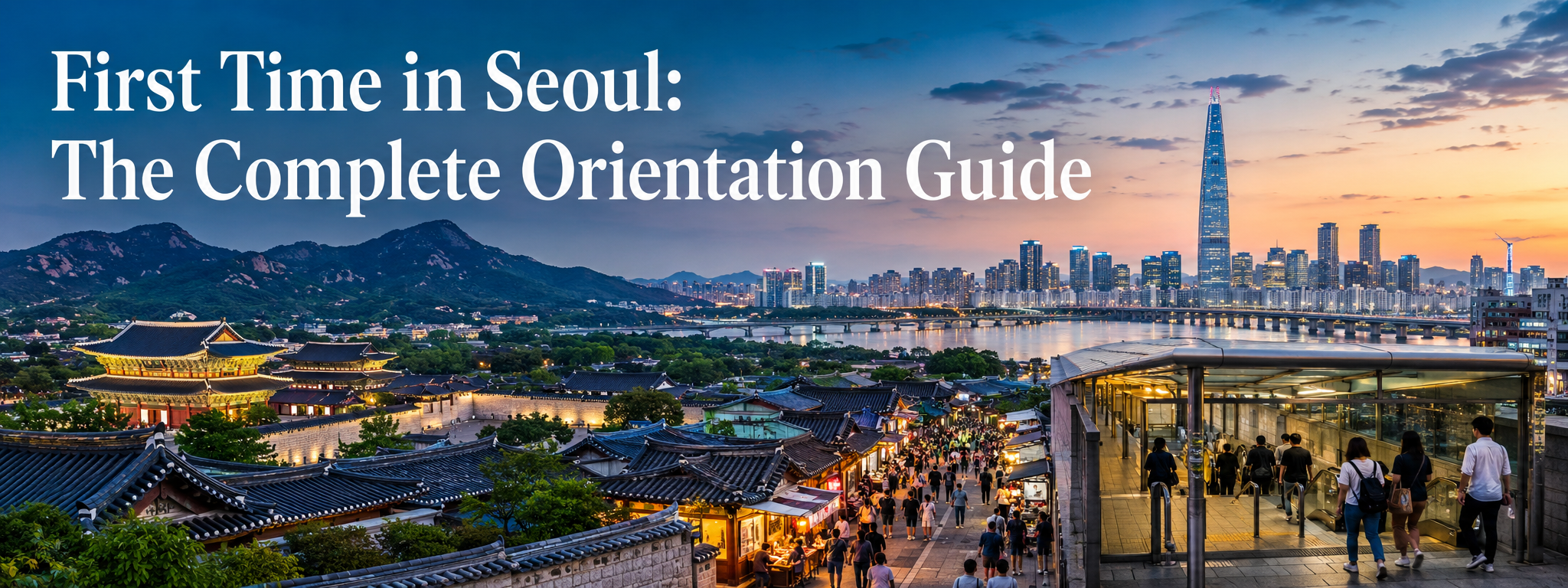

Seoul is not a city you understand by memorising a list of attractions. It is a huge collection of neighbourhoods spread across both sides of the Han River, with historic palace districts, university areas, fashion streets, business centres, residential quarters and nightlife zones that can feel like different cities. The good news is that the public-transport network makes those pieces surprisingly manageable once you plan by area rather than by individual sight.
Start with the right mental map
The Han River is the easiest first dividing line. North of the river, Gangbuk contains most of the historic royal core: Gyeongbokgung, Changdeokgung, Bukchon, Insadong, Jongno, Gwanghwamun and many of the places first-time visitors picture when they think of traditional Seoul. South of the river, Gangnam is newer and broader, with major business districts, shopping, entertainment and neighbourhoods such as Gangnam, Apgujeong, Sinsa and Jamsil.
That north-versus-south split is useful, but Seoul is better understood as several clusters. The historic centre around Jongno and Gwanghwamun works naturally together. Myeongdong and the City Hall/Namdaemun area form another easy central cluster. Hongdae, Yeonnam and Sinchon sit west of the old centre. Gangnam, Sinsa and Apgujeong sit well to the south-east. Jamsil is farther east again. Crossing between these clusters is straightforward, but doing it repeatedly in the same day wastes time.
Where should a first-time visitor stay?
There is no single best neighbourhood, but there are a few especially easy choices for a first trip.
- Myeongdong / Euljiro: convenient for central sightseeing, shopping, food and straightforward subway access. A strong default if you want to minimise decision-making.
- Jongno / Insadong: better if palaces, traditional streets and the historic centre are your priority. The atmosphere is calmer at night than Hongdae or central Gangnam.
- Hongdae: useful for nightlife, cafés, younger energy and Airport Railroad access. It is less convenient for some palace-heavy days, but excellent if evenings matter as much as sightseeing.
- Gangnam: polished, modern and well connected, but it puts many classic first-time sights on the other side of the river. Choose it because you want Gangnam, not because the name is famous.
Our best areas to stay in Seoul guide goes deeper into the trade-offs. The main thing is to avoid choosing a hotel purely because it looks central on a zoomed-out map. Check the nearest subway station and the actual journeys to the places you care about.
How many days do you really need?
| Time in Seoul | A realistic first-trip pace |
|---|---|
| 2–3 days | A compressed introduction: one palace cluster, one major shopping/food area and one nightlife or modern-Seoul neighbourhood. Skip the temptation to add a distant day trip. |
| 4–5 days | The sweet spot for many first visits: historic Seoul, two or three contrasting neighbourhoods, proper food time, shopping and one flexible half-day. |
| 6–7 days | Enough time to slow down, add museums or a Hangang afternoon, explore beyond the obvious districts and consider one day trip without cannibalising Seoul itself. |
| 8+ days | Useful if Seoul is the main destination rather than a stopover. You can explore neighbourhoods more deeply and add day trips while keeping unstructured time. |
If you are also visiting Busan or Jeju, do not treat a seven-day Korea trip as seven days in Seoul. Transfers, airport time and hotel changes consume more of a day than itinerary spreadsheets suggest. See our Seoul, Busan and Jeju comparison before splitting a short trip three ways.
What to organise before you fly
Entry formalities are the one part of this trip that should never rely on old social-media advice. Korea uses separate systems for visas, K-ETA travel authorisation and the e-Arrival Card, and the requirement depends on your passport and current policy. Read our Korea visa and entry guide, then confirm your own case through the official Korean government links on that page shortly before departure.
Also decide how you will get online. You do not need to pre-plan every restaurant, but mobile data makes Seoul much easier because you will use it constantly for maps, transit, translation, opening-hour checks and addresses. Compare eSIM, physical SIM and Wi-Fi options in our Seoul connectivity guide.
Finally, save your hotel name and address in both English and Korean if the property provides it. That is useful for taxis, late-night arrivals and situations where a map pin is clearer than a spoken explanation.
Your first hour in the city
Most long-haul visitors arrive through Incheon International Airport. Do not make your first transfer harder than it needs to be. Airport rail is usually the cleanest choice when your accommodation is near a convenient rail connection; airport buses can be easier with large luggage when there is a stop near your hotel; and taxis make sense for late arrivals, families or groups. Our airport-to-Seoul guide compares those options.
On arrival, resist the urge to schedule a major attraction immediately. Immigration, baggage, the airport transfer, finding the hotel and orienting yourself can easily turn an apparently early arrival into a tiring afternoon. A neighbourhood walk, simple meal and convenience-store stop are much better first-day goals than racing across the city for a timed booking.
Public transport: learn one system and Seoul opens up
Seoul Metropolitan Government recommends using a public-transport card such as T-money or Cashbee for buses and subways. Cards are widely sold through convenience stores and transport facilities, and the city has been expanding payment and recharge options for international visitors. Single-journey subway tickets still exist, but a reusable transport card is far more convenient for a multi-day trip.
The subway is the easiest backbone for first-time visitors. Stations use numbered exits, directional signage includes English, and the official Seoul Subway app provides route and station information. Visit Seoul currently lists typical subway operating hours as roughly 5:30 a.m. to midnight, while noting that exact times vary by station. Check the last train for your actual route rather than assuming every line shuts at the same moment.
Buses are excellent once you are comfortable, especially for journeys that are awkward by rail, but they are less intuitive on day one. Use a live transit app and remember to tap your transport card when leaving a bus so transfer rules are applied correctly. For a deeper explanation of cards, buses, taxis and late-night travel, use our getting around Seoul guide.
Plan days by neighbourhood, not by famous-name ranking
A poor first-time itinerary might combine Gyeongbokgung, Hongdae, Gangnam, Bukchon and Jamsil in one day because all five are famous. A much better day keeps adjacent places together and lets you walk between them.
- Historic Seoul day: Gyeongbokgung or Changdeokgung, Bukchon, Insadong and nearby Jongno.
- Central Seoul day: Myeongdong, Namdaemun, City Hall/Deoksugung and Namsan depending on your energy.
- West-side day: Hongdae, Yeonnam and possibly Mangwon.
- Gangnam-side day: Gangnam, Sinsa/Apgujeong or COEX, without repeatedly crossing the river.
- East-side day: Jamsil and its surrounding attractions, especially if Lotte World or the lake area is a priority.
This is also why a rigid hour-by-hour schedule is usually unnecessary. Pick one or two anchors for each day, then let the surrounding neighbourhood supply meals, cafés, markets and smaller stops.
Cards, cash and everyday payments
Seoul is highly card-friendly, but it is still sensible to carry a modest amount of Korean won. Small stalls, traditional markets, transport-card top-ups or an unexpected payment machine can make cash useful even when most of your day is cashless. Avoid carrying a large trip budget in notes; use cash as a backup and for small transactions.
For transit specifically, do not assume the same foreign bank card you use in shops will automatically work at every bus gate or recharge machine. Seoul is actively expanding open-loop and overseas-card payment options, but implementation is gradual. A dedicated transport card remains the simplest visitor setup in 2026.
Language: you can travel independently without speaking Korean
You do not need fluent Korean to navigate Seoul. Major subway information is multilingual, station exits are numbered, hotels and major attractions routinely handle international visitors, and translation apps bridge most routine interactions. Learning a few polite Korean phrases is still worthwhile, especially greetings and thanks, but language should not stop you from exploring independently.
Addresses can be more difficult than spoken interactions. Save map pins, screenshots and Korean place names when you are heading somewhere small or tucked into a back street. For the logic behind Korean street addresses and building numbers, see our Seoul address and navigation guide.
Food planning: do less research, but understand the rhythm
Seoul is one of those cities where over-planning every meal can make the trip worse. Reserve genuinely hard-to-book restaurants if they matter to you, but leave room for markets, barbecue, noodle shops, bakeries, cafés and whatever looks good when you reach a neighbourhood. Many of the best food decisions happen because you stayed somewhere longer than expected.
Do, however, learn the basics before your first Korean barbecue or shared meal so you are not decoding the format while hungry. Our Korean barbecue guide, street-food guide and Seoul etiquette guide cover the practical side.
Safety and getting help
Save the emergency numbers before you need them. In Korea, 112 is police and 119 is fire and medical emergency. The Korea Travel Hotline 1330 provides 24-hour multilingual tourism assistance and can help connect travellers to emergency services with interpretation. Seoul Metropolitan Government specifically directs international visitors to 1330 for tourist information and language help.
That does not replace ordinary travel judgement: keep track of your belongings in crowded areas, know how you are getting home before a late night, and take summer heat or winter cold seriously. Our Seoul safety and emergency guide has the detailed contacts and practical scenarios.
A realistic five-day first itinerary
| Day | Shape the day around |
|---|---|
| 1 | Arrival, hotel neighbourhood, easy dinner and transit-card/data setup. |
| 2 | Historic core: palace, Bukchon/Insadong and Jongno. |
| 3 | Central Seoul: Myeongdong/Namdaemun, City Hall area and Namsan if the weather suits. |
| 4 | Choose one strong contrast: Hongdae/Yeonnam or Gangnam/Sinsa. |
| 5 | Your interests: market and food day, museums, Jamsil, Hangang, shopping, or simply return to the neighbourhood you liked most. |
If you have extra days, then consider a day trip. Do not force the DMZ, Nami Island or Suwon into a short first visit simply because they appear on every package-tour list. Seoul itself has more than enough depth for five days.
Common first-time mistakes
- Staying somewhere because it looks central on a map. Check the nearest useful subway line instead.
- Crossing the city repeatedly in one day. Cluster sights and neighbourhoods geographically.
- Scheduling a palace immediately after an international flight. Build a forgiving arrival day.
- Assuming one payment method covers everything. Carry a transport card, a normal bank card and some won.
- Depending on one old entry-rule blog post. Re-check visa/K-ETA/e-Arrival requirements on official sites.
- Trying to see three or four major neighbourhoods every day. Seoul is better when there is time to wander.
- Ignoring the last train. Subway closing times vary; check your actual route before a late night.
- Using a day trip to fill an itinerary that is already rushed. Add one only when you genuinely have time.
First-time Seoul checklist
- Confirm your current entry requirement through the official links in our visa guide.
- Choose accommodation based on the trips you will actually make.
- Set up mobile data before or immediately after arrival.
- Get a reusable public-transport card and learn to use subway exits.
- Save your hotel address and key destinations in Korean as well as English.
- Group each sightseeing day by district.
- Keep one half-day flexible for weather, fatigue or a neighbourhood you want to revisit.
- Save 112, 119 and 1330 in your phone.
Official sources and current visitor information
This guide was reviewed in August 2026. For transport and visitor services that can change, check the original source close to your trip:
- Seoul Metropolitan Government — Public Transportation for transport cards, subway and bus guidance.
- Visit Seoul — Subway for operating-hour guidance, station use and visitor transport information.
- Visit Seoul — Transportation for bus, subway, taxi and transfer guidance.
- Seoul Metropolitan Government — visitor help information for the 1330 tourist hotline and emergency-service connections.