
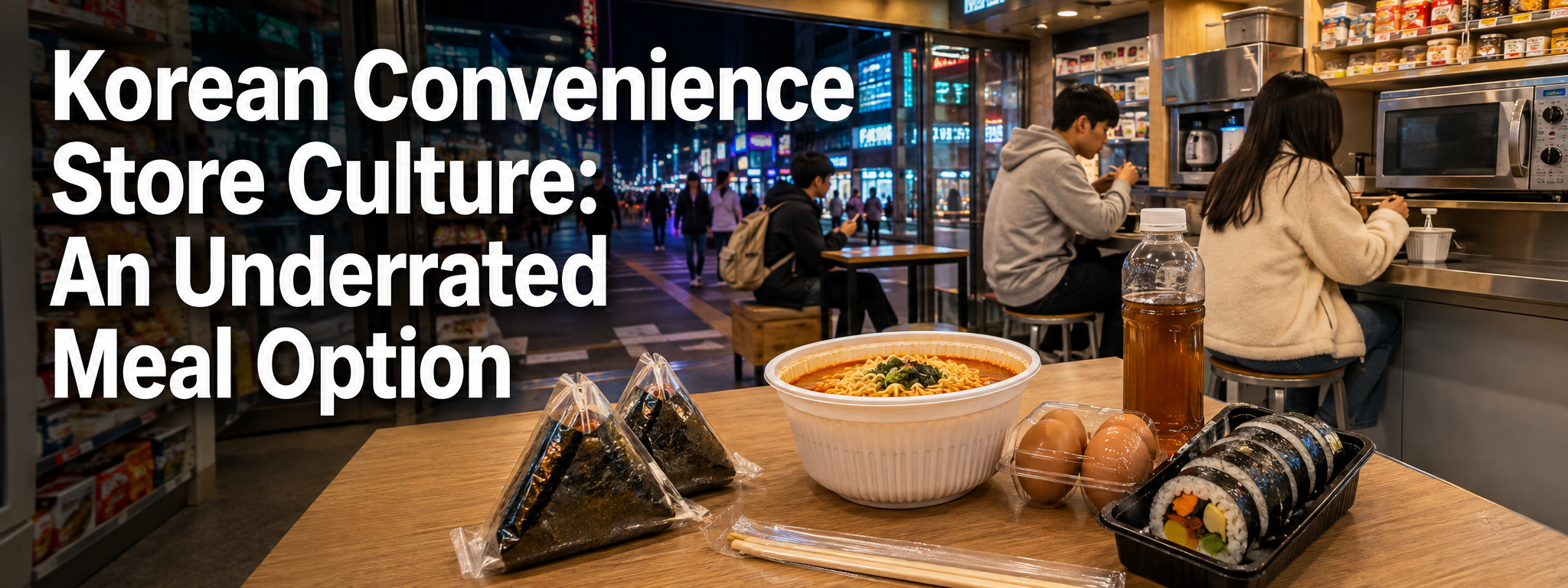

Convenience stores are part of the food system, not just emergency retail
Seoul’s convenience stores deserve more respect than the old three-section version gave them. CU, GS25, 7-ELEVEN and other chains are everywhere, and the official Seoul tourism guide explicitly treats convenience-store food as an everyday meal option rather than a tourist novelty.
I would not replace proper Korean restaurants with convenience stores, but I absolutely use the category in trip planning: breakfast before an early start, a late-night meal when the restaurant plan has collapsed, a train snack, or a cheap reset between heavier meals.
Start with the foods designed for grab-and-go eating
- Samgak gimbap — triangle-shaped rice snacks with a filling, compact enough for a quick breakfast or transit-day bite.
- Dosirak — boxed meal sets intended to be heated, useful when you want something more substantial without sitting down in a restaurant.
- Gimbap and sandwiches — easy portable options when you need food now rather than a food experience.
- Cup ramyeon — a genuine convenience-store staple, with hot-water facilities common at larger food-focused branches.
- Drinks, yoghurt, fruit, desserts and snacks — useful for filling the gaps around a normal Seoul eating day.
Microwaves, hot water and seating depend on the branch
Many Korean convenience stores are set up for food to be eaten immediately, with microwaves and hot-water equipment; some also have counters or seating. But not every tiny branch has the same layout, and a busy central store may be much less pleasant to linger in than a larger neighbourhood branch.
My rule is simple: buy according to the facilities you can actually see. If there is no seating, choose something portable rather than creating a balancing act on the pavement.
Convenience stores are excellent for awkward travel hours
The category earns its place when your schedule is least restaurant-friendly: early airport departures, a late hotel arrival, post-show hunger, jet lag, rainy evenings or the “everyone is too tired to negotiate dinner” moment. Visit Seoul’s current convenience-store guidance still highlights quick meals as a normal part of the culture.
That is why I call it a useful meal option rather than “cheap eats”. The value is not only price — it is predictability, speed and availability when the rest of your day has gone sideways.
T-money makes the store useful even when you are not hungry
VISITKOREA lists major convenience-store chains such as GS25, CU and 7-ELEVEN as places where travellers can buy T-money cards. Participating stores can also be useful for transport-card top-ups and everyday card-related errands, although exact payment methods and services can vary by store.
If your first Seoul task is “get mobile data, get a transit card, get water”, a convenience store may solve more than one of those jobs. See our getting around guide and connectivity guide for the parts that need more detail.
Read labels carefully if you have allergies or strict dietary rules
Convenience-store meals are packaged food, so ingredients and allergens matter. English labelling is not something I would assume across every product. If an allergy is serious, use a translated allergy card and choose products you can verify rather than guessing from the front of the packet.
Vegetarian-looking food can still contain fish, meat stock or other animal ingredients, just as it can elsewhere in Korean cuisine. Convenience is not a reason to relax the checks that matter to you.
Do not confuse “24-hour culture” with every branch being identical
Korean convenience stores are strongly associated with round-the-clock access, and many branches do operate 24 hours, but store hours, staffing and facilities can differ. Seoul’s official tourism coverage now includes unmanned and smart-store formats as well as ordinary staffed branches.
For a specific late-night need, check the actual branch rather than treating the chain logo as a guarantee of a particular service.
The fun part is trying things you would never buy at home
Limited products, seasonal snacks, unusual drinks and collaborations are a real part of the appeal. I would give yourself permission to make one deliberately random choice instead of trying to optimise every purchase from a viral list.
Just remember that social-media favourites change quickly. I would rather tell you how to use the store than hard-code a “must buy” product that disappears next month.
Where convenience stores fit in a good Seoul food trip
A proper Seoul food plan should still make room for Korean BBQ, street food, markets, temple food, classic dishes and neighbourhood restaurants. Convenience stores are the connective tissue between those experiences. They stop hunger from dictating bad decisions and make awkward time slots easy.
Official sources worth checking
- Visit Seoul — Convenience Store Food Course, edited in June 2026, for current visitor-oriented convenience-store food context.
- VISITKOREA — Transportation Cards for current T-money retail and transport-card guidance.
- Visit Seoul — GS25 DX LAB for a current example of Seoul’s newer smart-store format.
Cheers, Carpe Diem & never underestimate the emergency dosirak! 🍻⏳🍙
TATS Man
Your late-night-ramyeon, transit-card-topping Seoul food mate.